




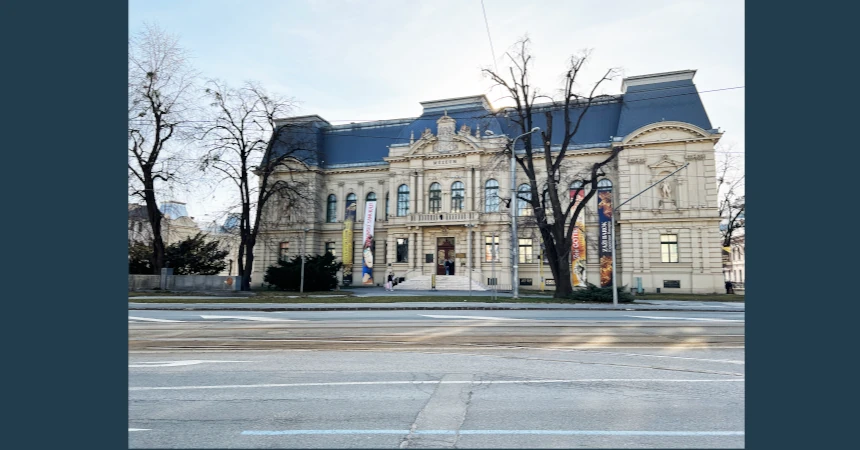
East Slovak Museum (Východoslovenské múzeum v Košiciach)

Wenn es kein Logo gibt, wird diese Spalte einfach leer gelassen. Das Bild oben bitte löschen.
(Dieser Text wird nicht dargestellt.)
Námestie Maratónu mieru 2
Košice
Slovakia
info@vsmuzeum.sk
Phone: +421 908 905 149
Opening hours:
Tuesday-Saturday: 9 am – 5 pm (closed Sunday, Monday)
 © Howard M. Berlin
 © Howard M. Berlin
 © Howard M. Berlin
 © Howard M. Berlin
 © Howard M. Berlin
 © Howard M. Berlin
 © Howard M. Berlin
 © Howard M. Berlin
 © Howard M. Berlin
 © Howard M. Berlin
When visiting Košice, one of the first things tourists read about the city is its gold treasure. Housed in the East Slovak Museum, the permanent exhibition is considered the largest and the richest coin find of gold coins in Slovakia, and is one of the world’s largest hoards of gold coins. It was discovered on August 24, 1935 in a copper casket during the reconstruction of a building a few streets away from the museum.
The exhibit is located in the museum’s lower level and reached either by stairs or an elevator (lift) for those with mobility issues. Cesta za Pokladom, or “Treasure Journey” is the theme for the three-room exhibition.
The first room presents information about how metals were mined and coins were made in medieval times. Additional panels give details about three additional hoards besides the famed gold treasure. The 1973 Bohdanovce Treasure was found in a ceramic jug, consisting of 12 ducats, 196 talers, 8 half-talers, and one 3 groschen. The youngest coin is a 1597 ducat of King Sigmund Báthory of Transylvania. Throughout the exhibition, all text is given in both Slovak and English.
The Levoča House Silver Treasure (2018-19) was found in the basement of a house near the museum. It consists of 606 silver coins from 15th-17th century.
The third hoard is the Obišovce Treasure of the One-Eyed Priest (2020). Found in a cracked jug of a church were 550 coins of which 484, copper polturas from the city of Banská Štlavnice along with 11 mining tokens. Among the copper polturas are rare specimens minted in 1687.
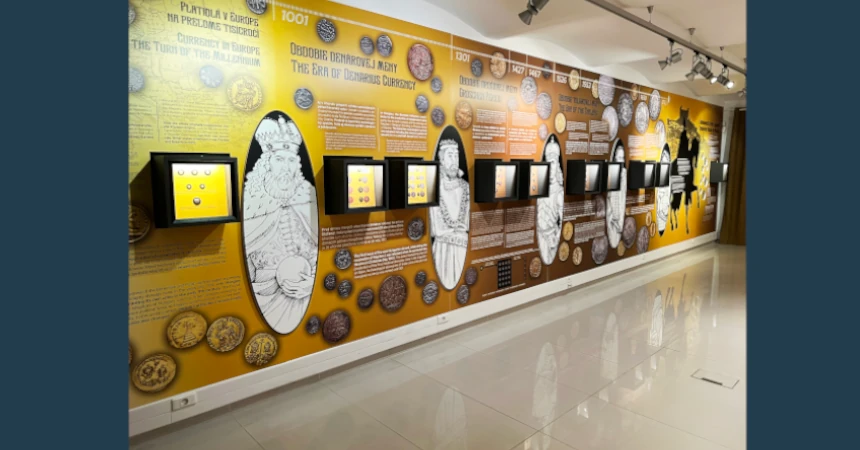
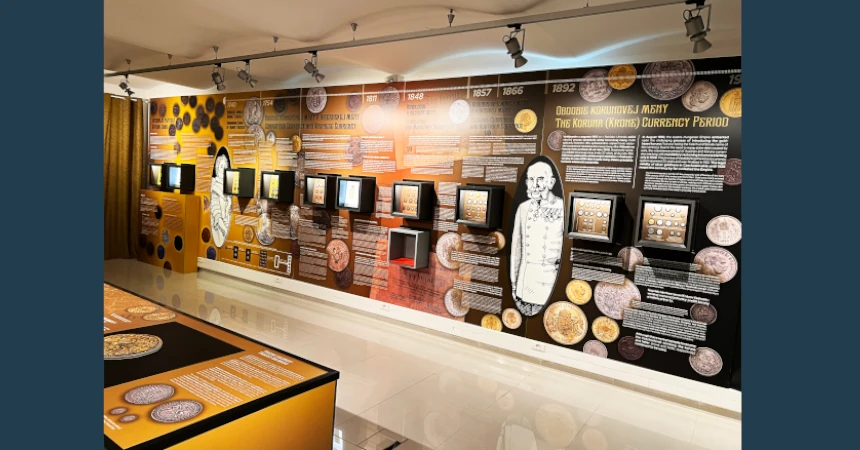
The second room’s exhibit form a timeline of major numismatic events of the region. Starting with European coinage at the start of the millennium, the timeline progresses with periods for the introduction of the denarius (1001), groschen (1301), talers (1526-1553), Hungarian Coins of Maria Theresa (1740), Convention and Viennese currency (1754), Revolution and Monetary Disruption (1848), Federal Currency and Austrian Currency (1857-1866), and ending with the Koruna (Krone) Currency Period (1892-1912). With each era, representative examples of gold and silver coins are displayed.
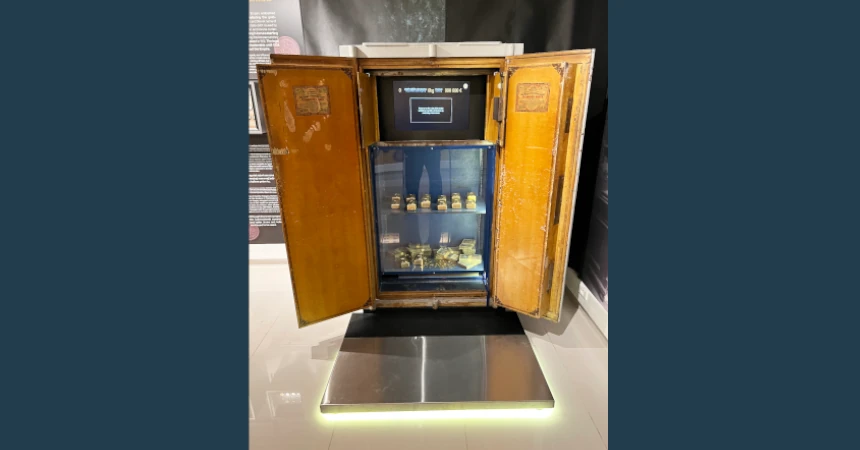
At the conclusion of the numismatic timeline, there is a safe containing 12 gold bars, coins, and bundles of old Austro-Hungarian currency. A scale and video display allows visitors to weigh themselves and the equivalent “gold value” is then displayed.
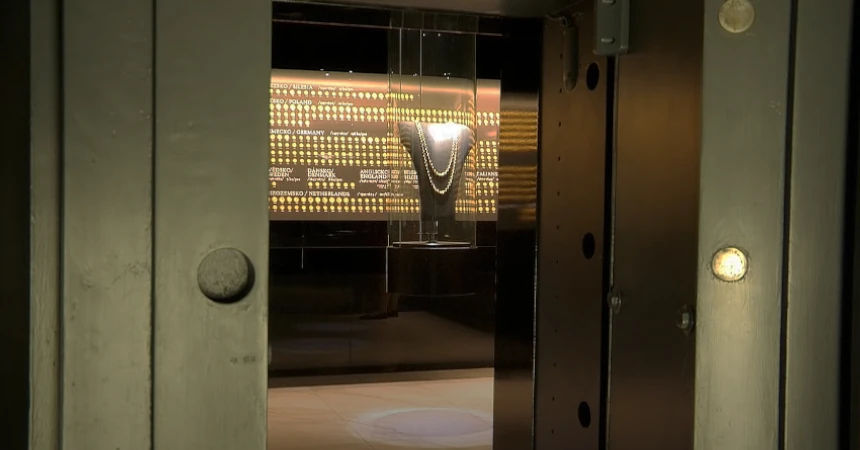
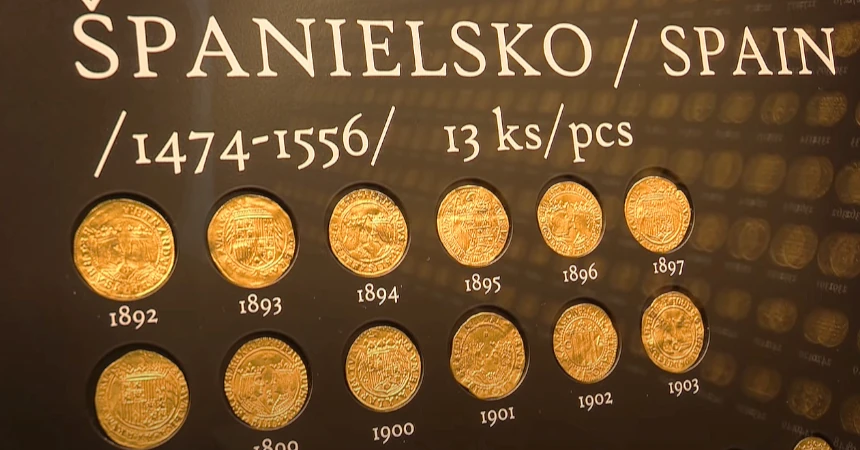
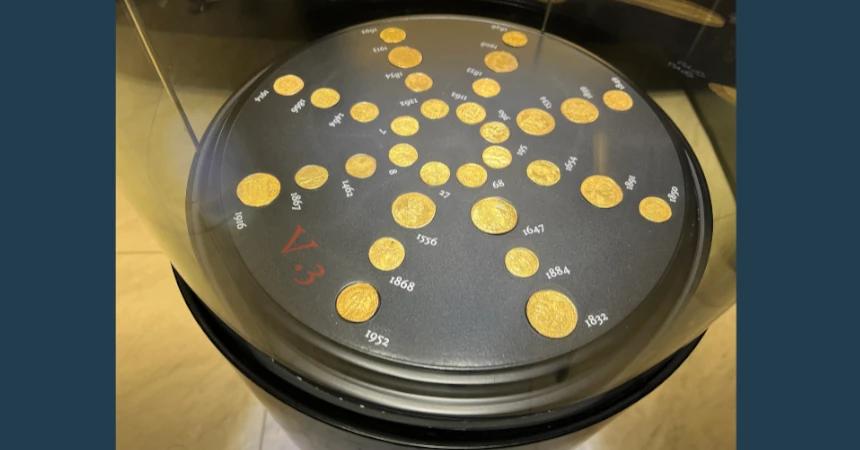
The final room, the highlight of the exhibition, is the showcasing of the hoard’s 2,920 gold coins from 16 different European regions in a bank vault-like room. Visitors have to enter through a bank vault-like door.
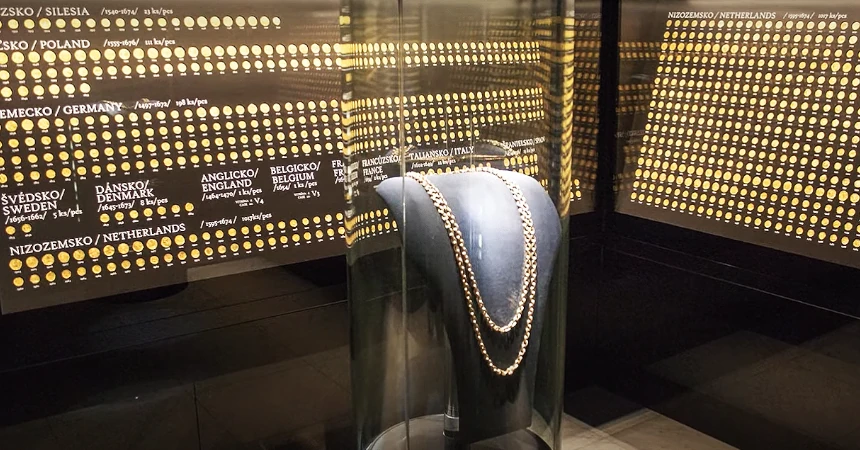
One inside, the many coins are spread out over panels, which are divided by region, and each coin is numbered for identification:
| Region | Number | Included Dates |
| Hungary | 1.187 | 1402-1679 |
| Transylvania | 251 | 1559-1657 |
| Bohemia | 26 | 1584-1650 |
| Austria | 24 | 1544-1656 |
| Salzburg | 31 | 1543-1652 |
| Silesia | 23 | 1540-1674 |
| Poland | 111 | 1555-1676 |
| Germany | 198 | 1497-1672 |
| Sweden | 5 | 1656-1662 |
| Denmark | 8 | 1645-1673 |
| England | 1 | 1654 |
| Belgium | 1 | 1654 |
| France | 2 | 1654 |
| Italy | 22 | 1602-1649 |
| Spain | 13 | 1474-1556 |
| Netherlands | 1.017 | 1595-1674 |
Even though the exact year the hoard was hidden is not known, the newest of the coins (1679) dates back to the reign of the Holy Roman Emperor Leopold I, suggesting 1679 or shortly after.
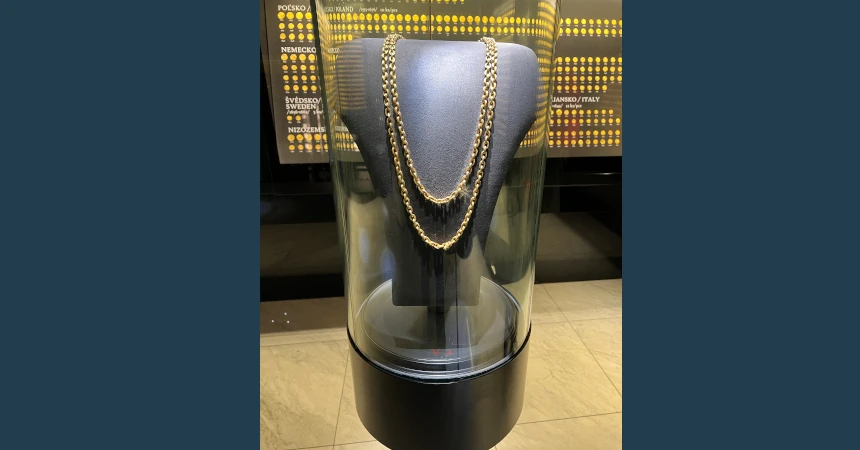
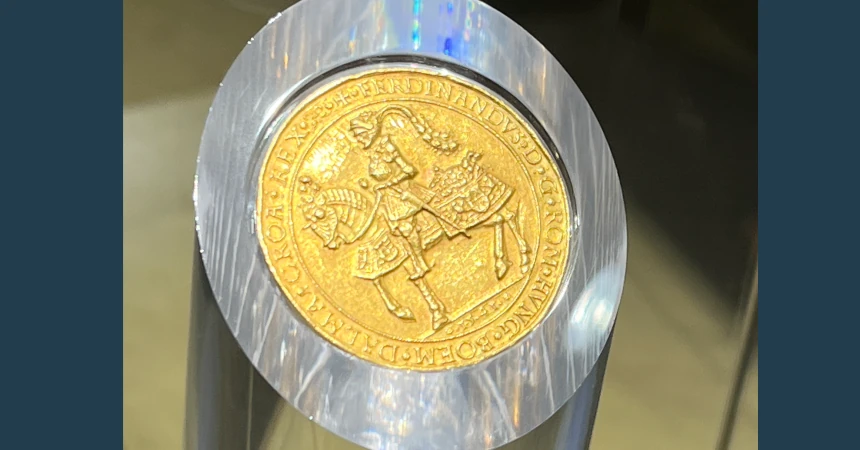
In addition to the 2,920 gold coins, the hoard includes three medals and a 84-inch (2.14m) long gold Renaissance chain. In all, the Kosice Gold Treasure totals 25.3 pounds (11.5 kilograms).
This text was written in 2025 by Howard M. Berlin. He has been discovering the numismatic world for decades and published his book The Numismatourist (available on Amazon) in 2014. He also has his own website.