




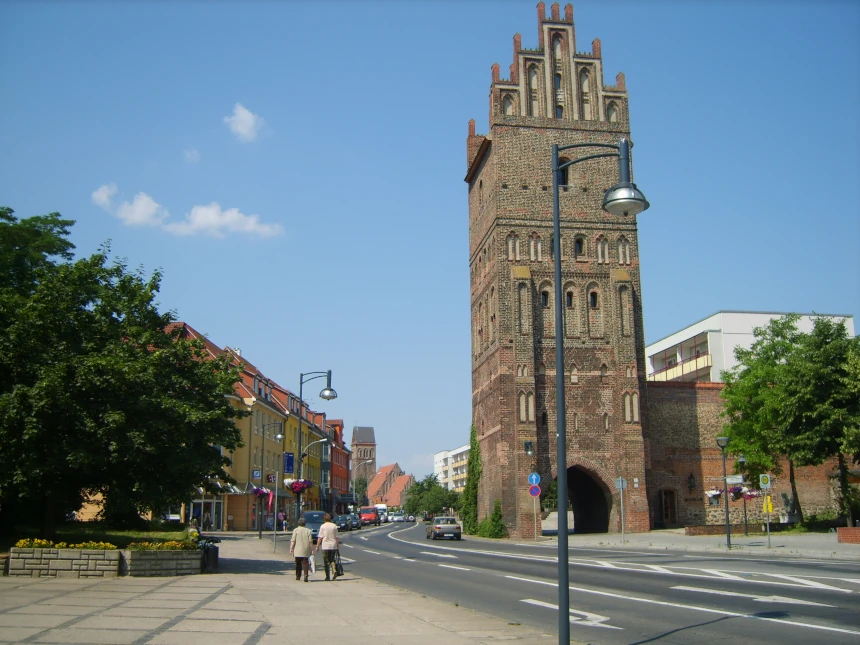
Museum im Steintor Anklam
Wenn es kein Logo gibt, wird diese Spalte einfach leer gelassen. Das Bild oben bitte löschen.
(Dieser Text wird nicht dargestellt.)
Schulstraße 1, D
17389 Anklam
Phone: +49 3971 245503
Opening times May – September:
Tuesday to Friday 10 am – 5 pm
Saturday, Sunday and public holidays 1 pm – 5 pm
Opening times October – April::
Wednesday to Friday 11 am – 3.30 pm
Saturday, Sunday and public holidays 1 pm – 3.30 pm
The Museum im Steintor is the oldest museum in Western Pomerania between Greifswald and Stettin. It is located in the highest brick Gothic city gate in Pomerania at 32 meters. Here you can find history and stories about the Hanseatic city of Anklam and the Peenetal region.
One story is dedicated to the so-called Anklam coin treasure. This is considered the most important archaeological hoard in Pomerania from the time of the Thirty Years’ War. Its hiding place was discovered in 1995 when a late Gothic cellar was uncovered in Wollweberstrasse. The hoard includes 2,579 coins, a number of silver and gold jewelry and everyday objects as well as appliqués and pendants for guild cups. Engraved silver spoons even allow conclusions to be drawn about a previous owner, a member of the Anklam brewing guild. The so-called “final coin”, i.e. the youngest coin in the find, bears the minting date 1629. The destruction of the house, in which wealthy citizens hid part of their property together or a looter hid his stolen goods, is documented for the year 1637. All of this points to a time of alternating occupation and destruction of the city during the Thirty Years’ War (more details here)
This hoard is on permanent loan from the State Office for Culture and Monument Preservation in the permanent exhibition of the Anklam Museum.
Another story to be explored in the museum is that of the Anklam “money-shitter”. “Money-shitter”, “Dukatenkacker” or “Heckmännchen” enjoyed great popularity in times past. At least the goblin has appeared in European legends since the late Middle Ages and also as an architectural detail, for example in Goslar or Stade. From the 19th century at the latest, the little men were also available as mass-produced goods that everyone could afford. As joke items or lucky charms, they were probably associated with the hope that they would bring money into the house – in whatever way.
The small clay figure presented in the museum was found in 2015 during demolition work on the east side of the Anklam market and has since had a remarkable career for its size of just over five centimeters: firstly, it was chosen as the find of the month by the State Office for Culture and Monument Preservation and discussed in detail. And most recently, a few pages in the current Anklam local calendar were dedicated to the little man with his pants down (sources: Kulturwerte-mv.de and the website of Museum im Steintor).
Text selection: Schmidt & Sturm, Erfurter Münzfreunde e.V.
Translated with DeepL