





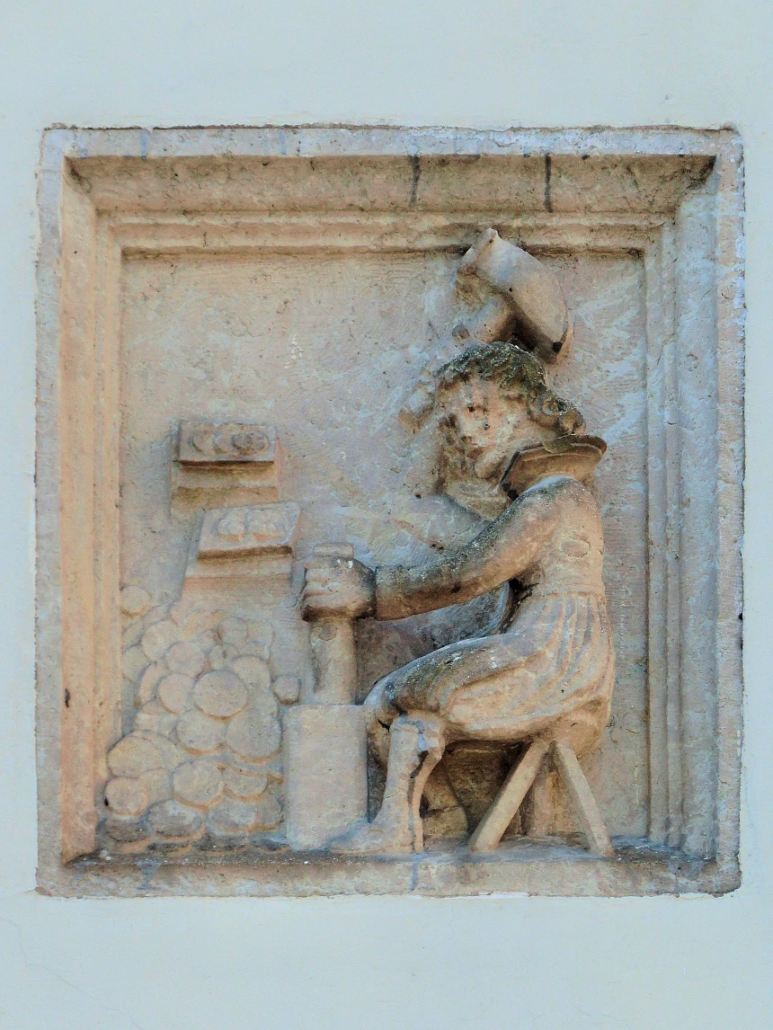
Building of the Former Mint with Wall Relief
Wenn es kein Logo gibt, wird diese Spalte einfach leer gelassen. Das Bild oben bitte löschen.
(Dieser Text wird nicht dargestellt.)
Ziegenmarkt 3
18055 Rostock
The building on Ziegenmarkt is said to have been built around 1500. However, there was already a previous building on this site, which has been documented as a mint since 1394. For historical context, it should be noted that the Hanseatic city of Rostock had already been granted the right to mint coins by Henry II in 1325 (for a time it was a member of the Wendish Coin Association of North German Hanseatic Cities) and in 1358 it had received full jurisdiction. With a population of over 14,000, it was one of the largest cities in northern Germany around 1410 – but did not make the step to becoming a free imperial city.
But back to the building of the old mint: in 1620 the brick building was plastered and decorated with Renaissance ornaments. This also includes the relief of the man striking a coin on the right side of the facade. Coins were minted at this location until the March Revolution of 1848 – despite the conflicts that flared up again and again between the city and the Dukes of Mecklenburg-Schwerin (in 1702 Rostock became a residence) and the military attacks by first Danish and Swedish, and later French troops.
“In the land register of the city of Rostock, the house is recorded as a mint with house and stall. … Older Rostock residents in particular will still be familiar with the Old Mint. The confectioner Alphons Herbst, who also ran a shop in Warnemünde, ran a successful confectionery shop under this name from 1928, which enjoyed general popularity. The café was still there until the early 1990s. In 1993 the house was converted into a bank branch.” (Source: mv-terra-incognita.de)
Text selection: Schmidt & Sturm, Erfurter Münzfreunde e.V.
Translated with DeepL.