

Segovia Mint
Wenn es kein Logo gibt, wird diese Spalte einfach leer gelassen. Das Bild oben bitte löschen.
(Dieser Text wird nicht dargestellt.)
Calle de la Moneda 3
40003 Segovia
Spain
Tel: +34 (0)921 475 109
casademoneda@turismodesegovia.com
https://www.turismodesegovia.com/en/royal-mint
Opening hours:
Wed.-Sat. 10:00 AM – 2:00 PM and 4:00 PM – 6:00 PM
Sun. 10:00 AM – 2:00 PM
(Last admission: 30 minutes before closing time)
 Aus Auktion Künker 410 (2024), Nr. 84.
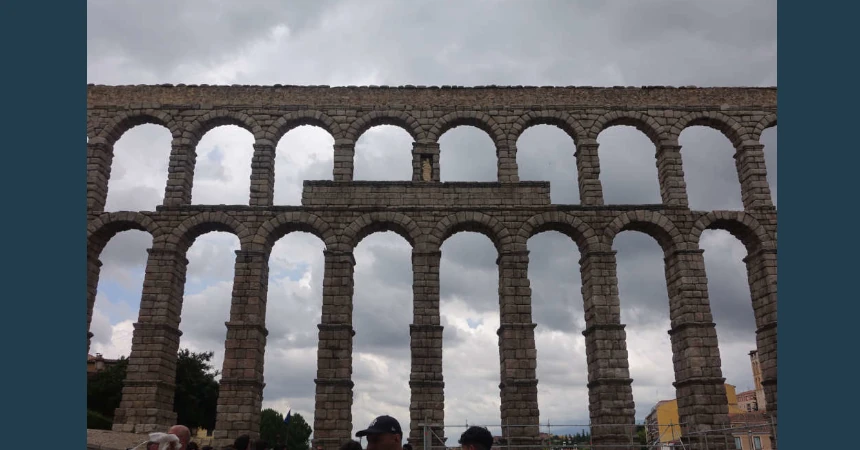 Foto: UK.
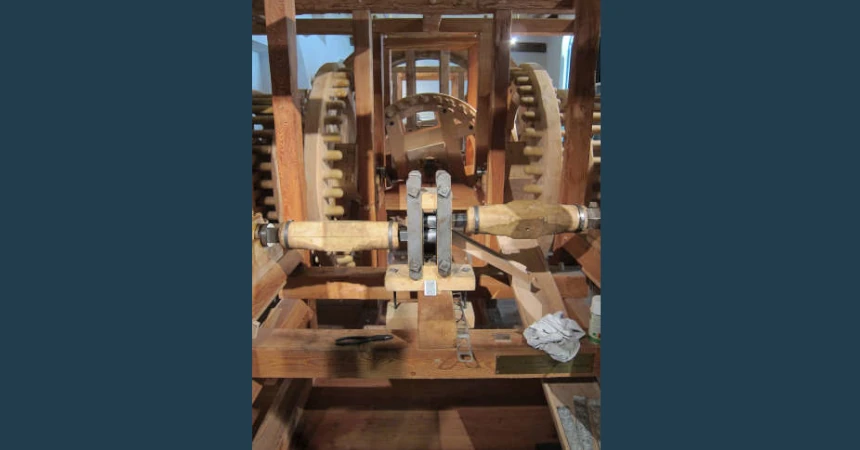 Foto: KW.
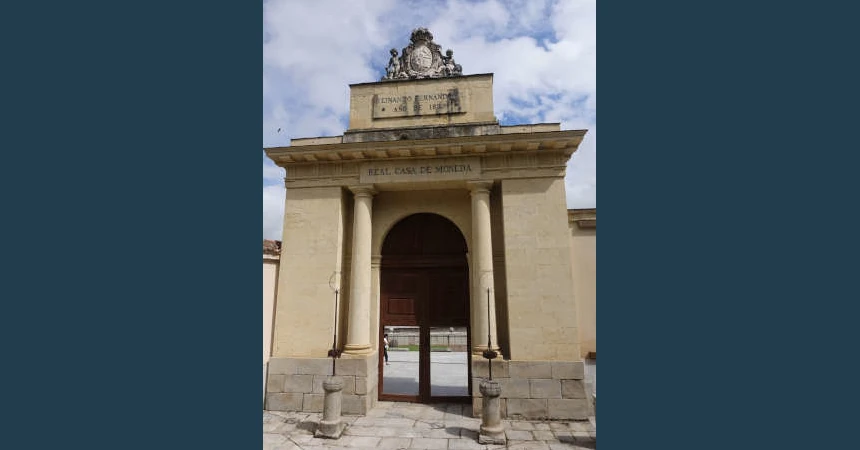 Foto: UK.
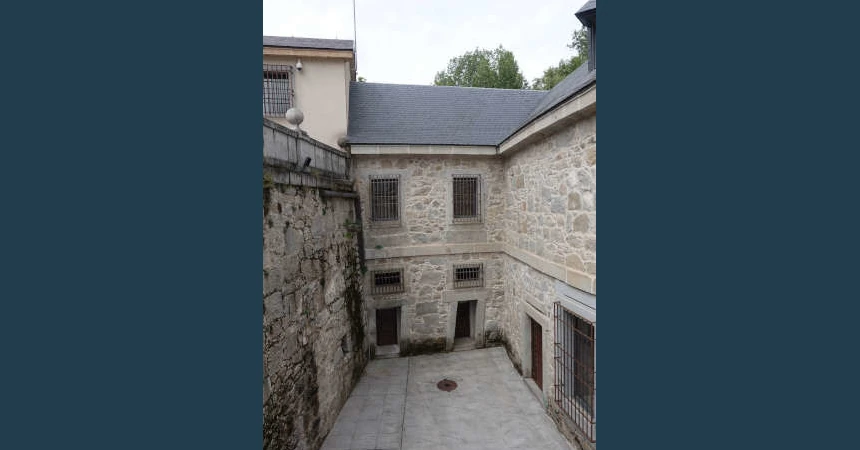 Foto: UK.
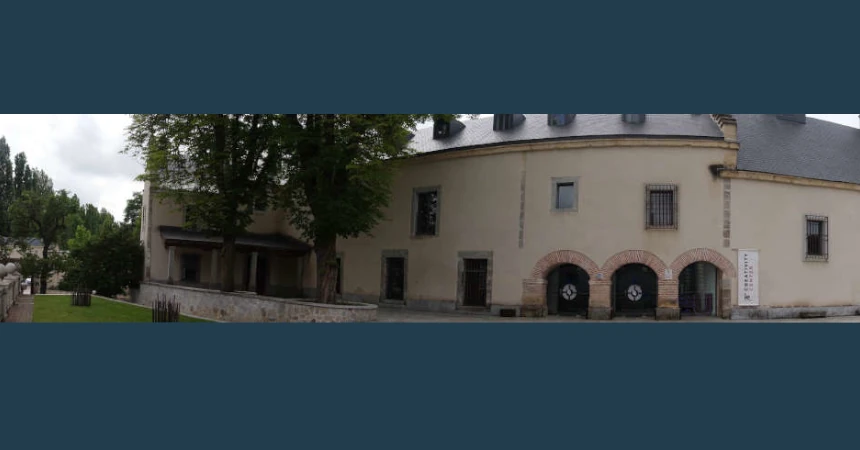 Foto: UK.
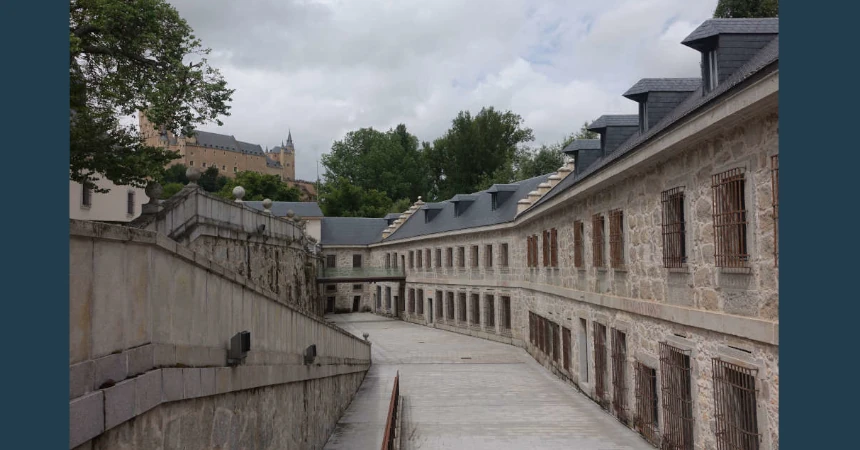 Foto: UK.
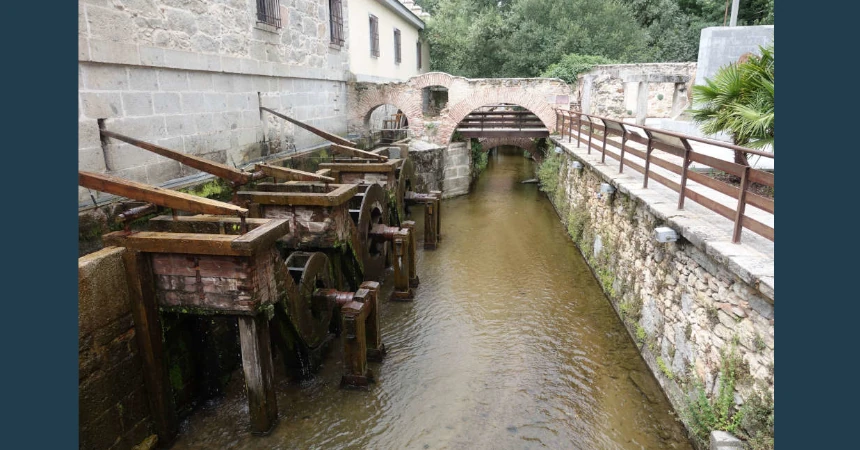 Foto: UK.
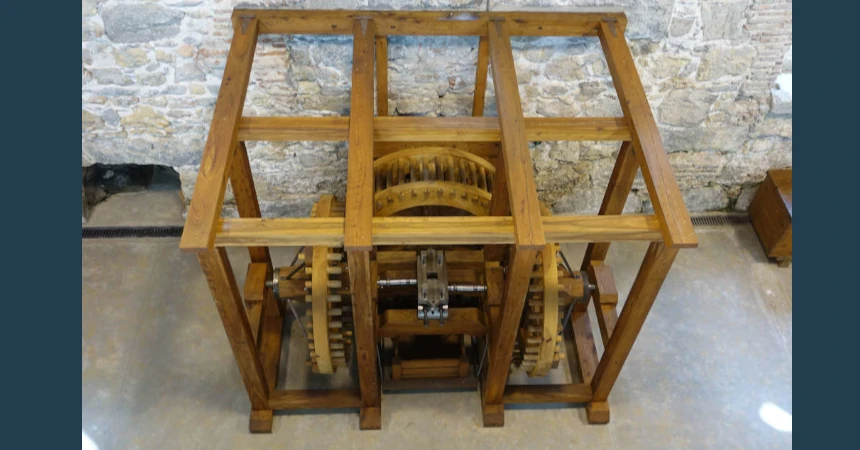 Foto: UK.
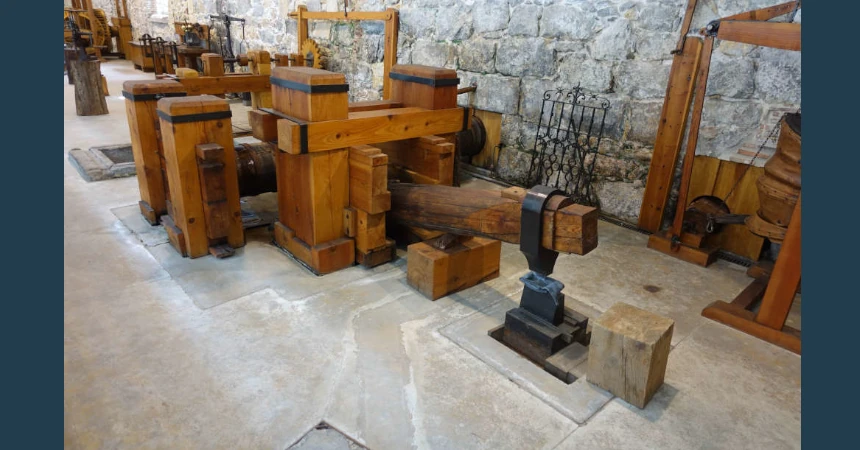 Foto: UK.
by Ursula Kampmann
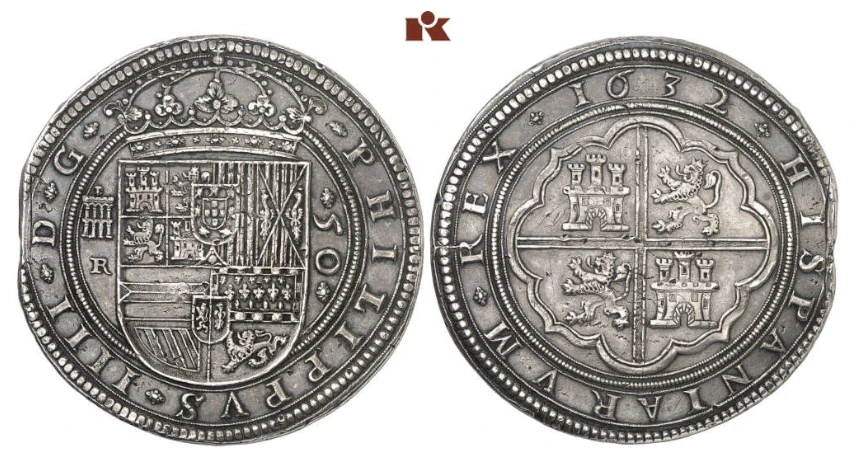
Looking at this coin, you will immediately notice a number of characteristics: First of all, the coin was struck with the utmost precision – even the smallest details of the coats of arms are clearly visible, even though the coin weighs a mere 170 grams! An enormous amount of pressure must have been applied to strike such a large surface with this level of precision! Then there is the missing piece on the left edge, the result of a clipped planchet. These two things indicate that this coin was not struck by hand, but created with the latest minting technology of the time: a roller press.
The design reveals where the issue was minted. In the left field, it shows a small section of a two-story aqueduct, reminiscent of the great Roman aqueduct preserved in the center of Segovia. The ruins of the former mint that produced this representative coin have also survived. They were neglected and abandoned for many years, until an American numismatist saw them, recognized their importance, and decided to devote himself to restoring this cultural heritage. Glen Murray succeeded. Where there were crumbling ruins two decades ago, there is now a museum where you can learn how coins were made in the 17th century. And the Segovia Mint is not just a single minting room, but an entire complex of buildings where everything is geared to roller press minting.
A Numismatic Revolution
At the beginning of the early modern period, European trade multiplied, resulting in an increased demand for heavy silver coins, i.e., talers. Traditional hand striking reached its limits. An innovative mind in Zurich therefore developed a method that would become the new standard in the industry.
Let us go back to 1554. During the Reformation, Zurich had confiscated church property that generated a surplus. And the Council of Zurich wanted to turn that surplus into coins. This required the minting of an average of 10,000 pounds of account per year. The 984,772 talers, 60 million groschen and 2.6 million fractional coins produced over six years by the St. Gallen mint master Hans Gutenson, who had been specifically hired for this task, and his 58 journeymen were not nearly enough. Council member and goldsmith Jakob Stampfer therefore developed a completely new minting machine: the roller press.
A roller press is basically a water-driven roller that can be used to roll a sheet of metal to any desired thickness. Jakob Stampfer had the idea of transforming the previously smooth rollers into coining rollers by engraving them so that they became the equivalent of upper and lower die. The rollers pressed the motif onto a sheet of metal that was fed through them. Traditionally, planchets were punched from these metal sheets after the rolling process. The innovation was that instead of punching planchets out of the metal that would later be struck into coins, the roller press produced a sheet of metal from which ready-made coins could be punched. If the metal was too short to produce a completely circular coin, this resulted in a phenomenon that is described as “clipped planchet” or “edge clip” in catalogs.
Jakob Vogler brought the roller press from Zurich to Hall. He was the last member of a group that had to tried to make money with this new minting technique. But neither the inventor of the roller press nor Jakob Vogler became rich as a result. It was the Tyrolean archdukes who became rich thanks to the invention of the roller press because they saved a lot of money as the new way of minting required much less skilled labor than hammer coining. However, roller press minting was only profitable in cases of mass production. This was the case in Hall, as silver from the Schwaz mine was minted into coins there, resulting in a mass production of talers.
When the Spanish Habsburgs were looking for a way to mint the silver from the New World in a cheap, quick and precise way, they asked their Austrian counterparts in Hall. The result was a transfer of technology. Six journeymen from Hall traveled to Spain to set up the new mint. For this purpose, they first had to find a suitable location. After all, roller presses depended on water power. And while Tyrol had plenty of fast-flowing streams, water was in short supply in Spain.
In 1583 Segovia was chosen as the site for the new mint. There was already an old paper mill that used the water of the Rio Eresma. It was here that the royal architect, Juan de Herrera, built the mint. Juan de Herrera is better known for El Escorial, which was built according to his plans and under his supervision. The fact that this important artist was commissioned to design the mint shows how much importance King Felipe II attached to the project.
In 1585, two roller presses arrived from Tyrol packed in boxes. They had to be reassembled before regular minting could begin in 1586. By the way, the first 100 coins created with the new roller presses were distributed to the city’s poor by royal decree.
A Tour of the Segovia Mint
But it would be wrong to assume that the museum is only focused on the minting process itself. Rather, the mint is a large complex that was specifically designed to transform the silver, copper, and gold it received into coins as efficiently as possible. By the way, it was not only the state silver of the Spanish treasure fleet that was coined here. Private individuals also turned to the mint to have raw metal minted into easily convertible coins for a fee.
The first thing every visitor sees is the large entrance gate. In the 16th century, this was the only entrance to the secure area, which was surrounded by high walls. To the left of the entrance was the guardhouse, which was manned day and night. This prevented unauthorized persons from entering the mint. If worst came to worst, the guard could use the jail right next to the guardhouse. Caught offenders could be imprisoned there.
Incoming goods were transported through the gate into the large complex of buildings on the right side. This was where the smelter and the assay furnace were located. Experts checked the purity of the incoming metal before it was taken to the scales. A clerk was in the room to record exactly who had brought what and how much. Once the silver had been accounted for, it could be locked away in the room next door. This walk-in vault had no windows. It was only accessible through the room with the scales.
On a lower level, but easily accessible via a ramp, was the great minting hall, where the roller presses did their noisy work. Driven by the power of the Rio Eresma, the wheels set in motion the heavy machines that produced the coins. Today the museum’s exhibition room is located here. Visitors can learn details about the history of the mint and its machinery. They can see archaeological finds from the mint and some original roller presses. Most impressive, however, are a number of working machines that are set in motion during the tours. These include the replica of a roller press and a hammer coining press.
From the minting hall, you can enter another room where metal sheets and – after the introduction of screw presses – planchets were produced and reworked. It was turned into a nice restaurant. A visit to Ingenio Chico is highly recommended.
This is the end of the tour, but do not forget to return to the ticket office. There you will find great literature on minting technology and numismatics. The works are available in Spanish and English.
If you are in the area, do not miss out on visiting the Segovia Mint! It is considered the oldest surviving example of industrial architecture in the world.